
Description
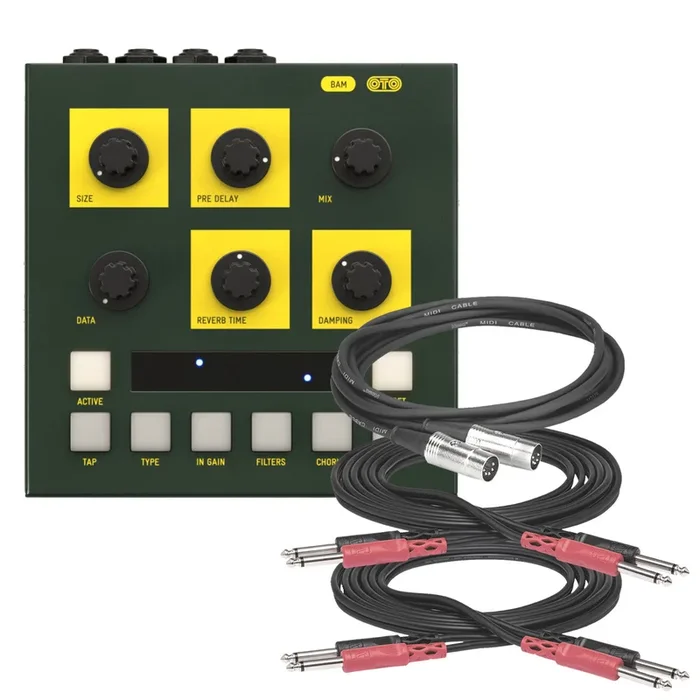
BAM is a stereo reverb processor inspired by late 70s / early 80s digital reverberator units. These units are sought after by sound engineers, producers and musicians for their grainy, warm and musical reverberations.
OTO Machines is passionate about the technology of digital reverberators, especially the old models. OTO listened carefully to all digital reverberators built from 1976 to 1986, studied their architecture and read all available papers (from 1961 to present) about digital reverb design.
They discovered that the musicality of the early digital reverb processors was partly due to the algorithms (the way the processor synthesized a natural reverberation), but also due to their hardware limitations. The audio signal was severely high-cut filtered (10 kHz was standard at that time) because of the limited sample clock. Some units used 12-bit gain stepping converters to achieve a 15-bit resolution and others used the first 16-bit converters. Then the samples were digitally processed through a 16- to 20-bit fixed-point CPU with limited memory.
The algorithms had to be simple but efficient to create the most musical and versatile reverberation from these limitations. And the hardware itself added grain and warmth to the sound.
The technology used in BAM is very close to what was used in the early digital reverberator units: 16-bit converters, 20-bit fixed-point processing, analog filtering and even an input transformer transient simulator. Some of its seven reverb algorithms are influenced by the early structures, while some are brand new.
BAM is a very musical and unique reverb processor in a compact format with MIDI control and 36 user presets. It mixes the sound quality of a vintage reverb processor with the playability of a modern desktop effect.
- Features
- Pre-delay up to 500 ms (via PRE DELAY pot) or 1500 ms (via TAP switch)
- Tap tempo assignable to pre-delay or reverb time
- 36 user presets
- Continuous control of the reverb size parameter for fine tuning
- Chorus parameter can add modulation to the reverberator signal
- Freeze switch
- Input gain up to +15 dB with analog clipping
- Reverb algorithms
- Room
- Hall
- Plate
- Ambient
- Chorus
- Non-Linear
- Primitive
- 3 bypass modes
- Relay: true bypass with reverb trails muted
- Spillover: electronic bypass with reverb trails preserved
- Aux: mutes reverb input with control over reverb level
- Filters
- Low-cut filter: 20 Hz, 80 Hz, 150 Hz, 250 Hz, 450 Hz
- Hi-cut filter: 1,8 kHz, 4,5 kHz, 7 kHz, 9 kHz, 15 kHz
- MIDI
- MIDI CCs for all knobs and parameters
- Responds to MIDI Program Change
- Physical
- Nice and simple user interface via 16 white LEDs
- Rugged steel enclosure
- Neutrik jack connectors
- Power supply included
- Dimensions 5.71″ × 5.71″ × 2.56″
- Weight 1.68 lbs.
Reviews
There are no reviews yet.